
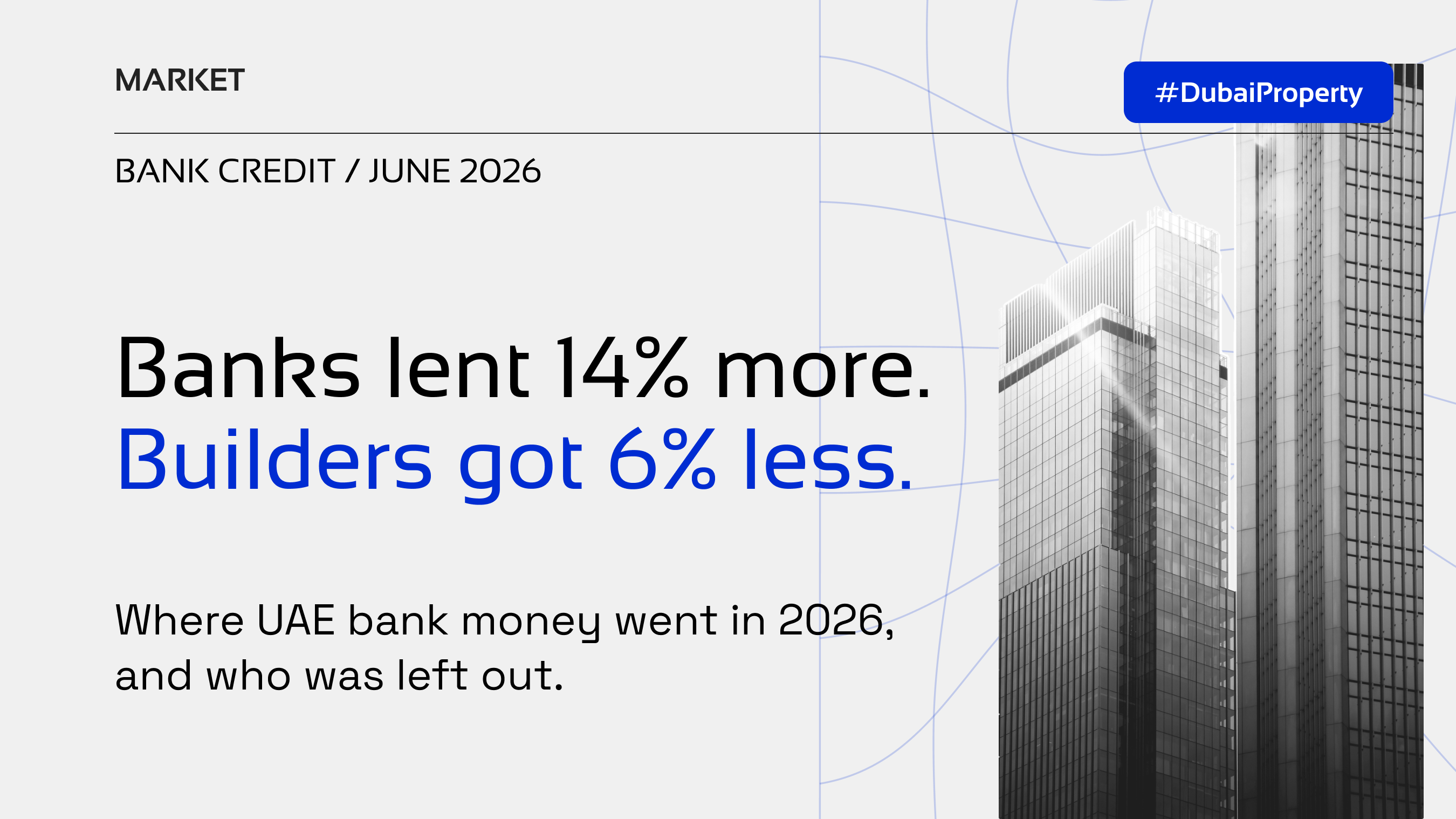
UAE banks are lending more than ever, but most new money goes to the government, state-linked firms and households. This analysis shows who gets bank money and what a bank checks before it says yes to a mid-sized company. It also shows when capital against a property is the better route.
In November 2026, one Abu Dhabi property group raised AED 13.7 billion from banks in a single deal.2 In the same month, Dubai awarded AED 56.5 billion of new airport contracts.5 Projects of that size run through main contractors, subcontractors and suppliers. They pay for staff and materials first and get paid later.
When those companies go to a bank, they face a different test from the largest companies. The Central Bank data below shows the difference.
After reading, you will know how a company raises money from UAE banks and who gets it on the cheapest terms. You will also know where a mid-sized company stands in that picture, and what it can do when a property stands behind the business.
A corporate loan is money a bank provides to a company, not to a person. In the UAE it usually takes one of three forms. The asset-backed alternative described below starts from a property instead of the company's file.
Large companies have a fourth option outside the banks: a sukuk, an Islamic bond sold to investors. The terms differ, but the first question is the same. Can this company repay from its own income?
How the smaller-company routes compare is explained in why banks underserve whole segments.
UAE banks had AED 2,798.9 billion of gross credit on their books in July 2026. That was 18.3% more than a year earlier.1 But the growth was uneven.
Where new bank money went
Credit to state-linked companies grew 26.4% in a year, and credit to the government grew 24.0%. Credit to individuals grew 14.7%. Credit to private companies grew 7.1%, the slowest of the four.1
Inside that company share, small and medium firms are a small part. In June 2026, banks held AED 96.1 billion of SME finance, out of AED 951.2 billion of credit to private companies.1 That is about AED 1 of every AED 10 that banks give to companies.
At the top of the market, banks compete to take part. Three deals from the last two months show the range.
All three companies have something a mid-sized company rarely has. They have audited group accounts, a rating or a long bank record, and a size that lets a bank spread the risk. Even so, Arada's sukuk pays 8.875% a year.4
Bank credit by sector, a year apart
The sector data shows the same split. From June 2025 to June 2026, bank credit to residents grew 13.8%. Credit to real estate activity grew 13.8% as well. Credit to construction fell 5.7%, from AED 47.1 billion to AED 44.5 billion.1
That is the sector now taking on the airport work. The new contracts bring the total awarded for Al Maktoum International Airport to more than AED 80 billion. The first phase is expected to open in 2032.5 A contractor on that kind of project pays for labour and materials months before its invoices are paid. Why that gap opens and how a business can carry it is explained in working capital in Dubai and the property-backed alternative.
Developers below the top tier face a version of the same problem. Their cash is locked in finished units while the next phase needs paying. This case is shown in where a mid-size developer's cash gets stuck, and what releases it.
A bank tests the company first. The Central Bank's latest full survey of small firms is from 2020. In it, weak business performance was the most common reason for a refusal, named for 70% of rejected firms. Banks also asked for audited accounts.6
Owners ask about this in their own words. In a Dubai forum thread in October, a company owner asked a simple question. Should the owner take a personal or a business loan for the company's rent, or is there an alternative? Another reader in the same thread asked why it is so hard for a business owner to get money from a bank at all.
The answer is in what the bank checks. A personal product looks at the owner's salary. A business product looks at the company's accounts, trading history and cash flow. When the company is having a hard month, both tests can fail at once. Bank standards also moved in 2026. In the second quarter, banks reported tighter collateral requirements, and refusal rates for business requests rose, including for SMEs.7
The full list of what UAE banks ask an SME for is in the alternatives to an SME bank loan in the UAE.
It depends on the size of the company. The largest companies can raise money without pledging a single asset: Arada's 2026 sukuk was senior unsecured.4
Smaller companies usually give security. In the Central Bank's survey, three in four small firms that received bank finance gave collateral, most often money owed by their clients. Cheques and the owner's personal surety came on top.6 In 2026, banks asked for more collateral, not less.7
Many mid-sized companies, or their owners, hold property in the UAE: an office floor, a warehouse, a villa. A bank often looks at that property last. The asset-backed alternative looks at it first.
NEMAX is not a bank or a lender. It is the asset-backed alternative: it structures co-financing secured by the property.
For the term of the deal, the property is held by an SPV, a separate company set up for this one deal. The SPV is registered in ADGM, the Abu Dhabi Global Market. NEMAX holds a share in that company for the term. You keep the use of the property.
Here is an illustrative example, with indicative figures. A contracting company owns an office floor with a recent value of AED 6,000,000 and no mortgage. 70% of AED 6,000,000 is AED 4,200,000, so the capital could be up to AED 4,200,000. This is not a quote and not a commercial offer. The final number is set after valuation, an independent estimate of the price.
Does your company need capital by a date, and is there a property in the UAE behind it? NEMAX reviews the property and its recent value, and confirms in writing what it can support, before any commitment.
The first reply comes within 48 hours. This first reply is not yet a funding decision. The valuation is often the longest step.
The same idea runs through much larger deals in the region, as shown in what asset-backed finance in private credit looks like in the UAE.
The term is at least 12 months, with extensions case by case. The fee is paid monthly, like rent, so plan it into the cash flow before you apply. The capital itself is returned at exit: at the end of the term, from a sale or a refinance, which means replacing it with new finance.
For a company, there are usually three exits. Clients pay the invoices that created the gap. The property or another asset is sold. Or a bank facility replaces the capital once the company's accounts are stronger. Write the exit down before the deal starts, with a date.
Some companies need something else.
If none of these applies, the property behind the business may already hold the capital it needs.
It is money a bank provides to a company, usually as a term facility, a revolving facility or a syndicated facility. The bank looks first at the company's accounts. The asset-backed alternative starts from a property the company or its owner holds, from AED 1.2 million.
Prepare audited accounts, bank statements, the trade licence and the company's payment record. Banks test whether the company can repay from its own income.6 As an alternative, a property in the UAE can carry the request, up to 70% of its recent value less any mortgage.
It is bank money for a business purpose, such as stock, equipment, property or running costs. It is priced on the company's file and often needs security.6 The asset-backed alternative is priced on the property, with a monthly fee and the capital returned at exit.
Large companies with audited accounts and a long bank record get the most. In the year to July 2026, credit to private companies grew 7.1%, against 26.4% for state-linked firms.1 For a mid-sized company with a property, the asset-backed alternative is one route.
The largest companies can: some raise money unsecured.4 Most small firms give security, often cheques, the owner's surety and money owed by clients.6 The asset-backed alternative is secured by the property from the start, so it does not ask for those.
Banks and licensed finance companies provide most business finance, through facilities, trade finance and invoice products. NEMAX is not one of them. It is the asset-backed alternative: co-financing secured by a property in the UAE, with the property held by an SPV for the term.
It is one facility from a group of banks, on one set of terms, arranged by one or more lead banks. In November 2026, Modon raised AED 13.7 billion this way.2 A smaller company rarely reaches that market. The asset-backed alternative starts from a property instead.
Both exist. The largest companies raise money unsecured; Arada's 2026 sukuk was senior unsecured.4 Three in four small firms that got bank finance gave collateral.6 In 2026, banks asked for more collateral.7
It is harder for smaller firms. Weak business performance is the most common reason for a refusal.6 In 2026, refusal rates for business requests rose, including for SMEs.7 The asset-backed alternative looks at the property and the exit first.
Bank terms vary with the product: Modon's term facility runs five years, and its revolving facility three, extendable to five.2 The asset-backed alternative runs for at least 12 months, with extensions case by case.
A personal product tests your salary, and a business product tests the company's accounts. If the company is having a hard month, both can fail. If you or the company hold a property in the UAE, the asset-backed alternative starts from that property instead.
Banks check the company's income, history and accounts first, and most small firms are asked for security.6 In 2026, banks reported tighter collateral requirements.7 An owner can hold a valuable property and still fail the bank's test, because the test starts with the company's accounts.
When the bank looks only at the company's accounts, NEMAX reviews a property the company or its owner holds in the UAE, then confirms in writing what co-financing secured by the property can support, from AED 1.2 million.
Apply for capital →




We use cookies to improve website performance and analytics. By continuing to use the site, you agree to their use. Learn more